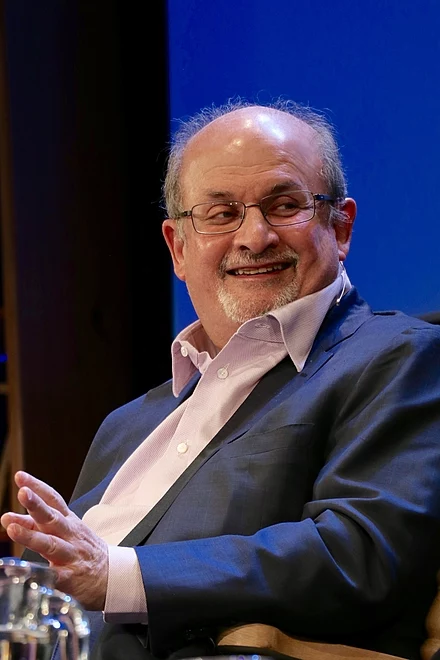
Rushdie’s eleventh hour and intimations of literary mortality


Somerset Maugham was not quite himself in his waning years and he knew it.
My father, a cardiothoracic surgeon who read voraciously, was a great fan of Maugham. As a child, I remember him recounting the story of the critic who had travelled a ways to interview the great writer. On meeting Maugham, the critic ruefully told an editor that he found the writer but as for meeting him, ‘alas, I am 20 years too late’.
Or words to that effect.
For a child, it was a great lesson in the wisdom that should come with age, of recognising the limits of the body, the ravages of time.
So it is that the celebrated singer’s voice becomes reedy on account of presbylaryngis, a fancy way of saying the vocal cords become old and no longer close properly. Paul McCartney is an example.
And so it is that the noted writer has said what they had to say, many times, in felicitous prose. Once, it burst upon the world like a lightning flash, bright and sharp with truth. Then, it garnered every award possible. Now, the writer is repetitious, tediously trawling at ground level over compacted soil once rich in anecdote and drama. As Julian Barnes noted last month, his new novel, Departure(s), will be his last, because “I’ve played all my tunes”.
Julian Barnes is a wise man. He is conscious of literary mortality, when the writer’s body is fine (more or less) but his art has withered on the boughs of time.
Maugham too was conscious of literary mortality.
He died in 1965, aged 91, but wrote his last major novel in 1944. Though he continued to write the occasional essay well into his 80s, Maugham was acutely conscious that he no longer had the drive to tell a story. Nor, in fact, that he had a story to tell.
In the sunset of his literary life, Maugham told a friend, “Decent people often say to me, ‘Why don’t you write another Of Human Bondage?’ and I reply. ‘Because I’ve only lived one life. It took me 30 years of living to possess the material for that one work.’”
Maugham’s friend asked: “But what about the 30 years that followed?”
Maugham thought for a moment, as though reviewing them, and said simply, “Well, the next 30 weren’t quite so fruitful.”
[The account above is detailed in The New York Times, dated September 4, 1966, under Garson Kanin’s byline.]Mr Rushdie, one of contemporary fiction’s greatest exponents, may have had a more “fruitful” later life than Maugham’s.
The trouble is, he has no new stories, nor, seemingly, any way of retelling the old.