How do you get from Gaza, the existing place, to Trump’s glossy ‘new’ version?

Donald Trump’s son-in-law Jared Kusher had one word right on Gaza when he unveiled the “amazing investment opportunities” available in the Palestinian territory: “catastrophic”.
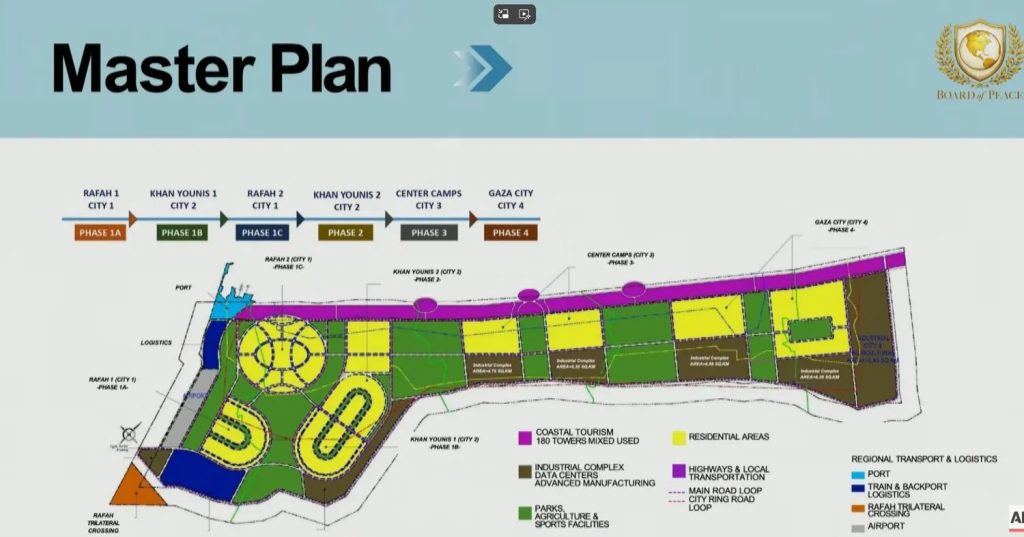
Mr Kushner said, “let’s just plan for catastrophic success” as he showed glossy images of skyscrapers along the Mediterranean coast and housing estates in Rafah. The only problem: The slideshow was about a place called “New Gaza”, which doesn’t exist and whose outline throws up huge questions revolving around Gaza’s roughly 2 million population.
Would Gaza’s people be still allowed to call it home? Or would they be elbowed aside, in favour of smart, newly developed residential complexes, high-tech hubs and hip beach resorts?
The Trump administration has denied its “New Gaza” plans will move people out. Even so, there was a deep and troubling dissonance between the reported situation on the ground in Gaza and the images displayed by Mr Kushner and watched approvingly by Mr Trump.
In Gaza, people continue to die of cold and disease and sporadic military firing by the Israeli army. Gaza urgently needs food, medical help and shelter, not grand dreams (though it’s good to dream however desperate the situation).
Accordingly, the biggest question is this: How does one get from Gaza, the existing territory, to “New Gaza”, the fabulous Trumpian vision of the future?
As analysts have pointed out, to rebuild Gaza will require large amounts of cash. According to World Bank and United Nations estimates, it may be $70 billion.
While regional governments, particularly Saudi Arabia, Qatar and the United Arab Emirates can be expected to help, they are hardly likely to pay for the whole. Naturally then, the private sector will have an important role to play in Gaza’s redevelopment.
But who will supervise the flow of money, keep tabs on it and furnish accounts the world can interrogate?
It’s hard to see that role going to Mr Trump’s Board of Peace, which was launched with great fanfare in Davos on Thursday (January 22).
Some have described the Board of Peace as a vanity project. Others suggest it might credibly double as a pension plan in perpetuity for Trump senior and his immediate heirs and successors.
The Board of Peace matters profoundly to and for Gaza.
In November, a UN Security Council resolution designated the then-proposed Board of Peace as a key entity to “set the framework, and co-ordinate funding for, the redevelopment of Gaza”. The World Bank subsequently began to plan for a massive Gaza Reconstruction and Development Fund. The Fund was “expected to be a catalyst for private investments, which are central to the rebuilding of Gaza” and the Board of Peace was meant to spend that money or at least to apportion it appropriately.
But now, with the Board of Peace set up in the way it is, there may be less confidence in its governance and intentions and this may affect Gaza’s prospects, both immediate and longer term.
First and foremost, Mr Trump’s Board of Peace does not appear to be focussed on Gaza. It seems to have its eyes set on more distant horizons, with its charter suggesting it wants to ‘do’ peace in far-flung parts.
Second, it’s available as a permanent clubhouse for anyone with a billion dollars in cash and all its decisions are “subject to the approval” of Mr Trump. That includes the authority to turf out members (though presumably not the ones who paid $1 billion?)
Unsurprisingly, as of now, the Board of Peace doesn’t inspire confidence that Gaza’s needs will be looked after, let alone that the shattered territory will be rebuilt into “New Gaza”.
Members of the Board of Peace’s newly constituted Palestinian committee to administer Gaza haven’t even managed to visit the territory as yet. The “executive committee” that is supposed to put into operation the overall Board’s decisions has no Palestinian members. And most dangerous of all is the prevailing situation in Gaza, where the three-month ceasefire has not prevented fighting and the deaths of several hundred Palestinians since November.
This is not to be churlish about the “New Gaza” plans. This is not to say dreams aren’t nice to have. Never say that those on the edge can’t look up at the stars. But plans for a long-term recovery for shattered Gaza should not be prioritised over and above its immediate humanitarian needs.