What would Graham Greene have made of St Carlo and his laptop?

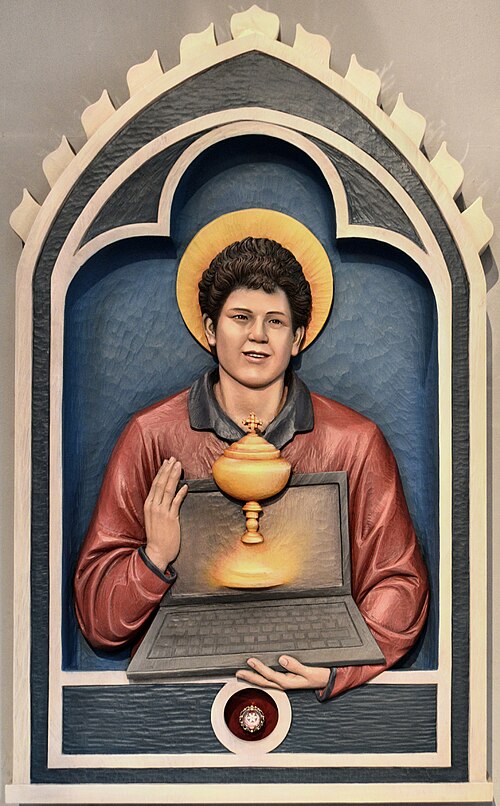
A memorial to St Carlo at Corpus Christi church in London. Photo by AndyScott. CC BY-SA 4.0
London is marked by continuity and change and its most faithful chroniclers capture this.
Graham Greene’s The End of the Affair features the city’s oldest restaurant, Rules. Founded in 1798, the establishment rejoices in its stability. Its website bears the boast that it’s been owned by just four families in 200 years!
The novel also features Corpus Christi Catholic Church, where continuity and change are the order of the day. The establishment, about a century younger than Rules, has a shrine to the Catholic church’s newest saint, Carlo Acutis.
The 15-year-old London-born Italian website designer was beatified in 2020 and canonised just last month canonised by Pope Leo XIV. Referred to as the “patron saint of the Internet” and the “first millennial saint”, the church has an image of the young man holding a laptop and a chalice.
One has to wonder what Greene, a Catholic convert, would have made of St Carlo. He has become something of a phenomenon among young believers and Silicon Valley techies. Greene, acutely sensitive to public mood, would probably have recorded that in some way. As he did the intense religiosity of Mexican peasants.
Visiting Mexico to write a non-fiction piece on the persecution of the Catholic clergy, Greene noted that the peasants’ faith “assumed such proportions that I couldn’t help being profoundly moved”.
Ultimately, he would commit it to literature, as the gripping novel The Power and the Glory.